
AI Tools for Freelancers (2026): Which Ones Still Pay You a Year Later
GoHighLevel, n8n, Make, Zapier, LangSmith, Voiceflow and Xpectrum, compared for freelancers who build automations for clients. Nearly all of them pay you a share. What differs is how long they keep paying, and whether they pay for the agent you built or only for the client you signed up.


Key takeaways
- Nearly all of these pay you a share of what your client spends, so that alone decides nothing.
- Most pay 30 to 35%, then stop after twelve months while your client carries on paying.
- Only GoHighLevel and Xpectrum keep paying for as long as the account lives, both at 40%.
- Xpectrum is the cheapest to run: one charge per run, where Make charges per step and costs 4.5 times more.
You build automations for other people’s businesses. You pick a platform, you deliver, you invoice once, and then your client pays that platform every month for years while you are still the person they ring when it breaks.
Most comparisons will not help you with that, because they compare features and monthly prices as though you were the one buying. You are not, really. You are choosing on someone else’s behalf, carrying the consequences, and getting paid once.
The useful news, which vendor blogs tend to skip because it is inconvenient for them: nearly every tool here will pay you a share. Make, n8n, Botpress, GoHighLevel, Voiceflow and Zapier all run a partner programme. So do we. The question worth asking is therefore not who shares revenue, it is for how long, and for what, and that is where they stop looking alike.
Prices and programme terms below were checked in October 2026 and all of them change. Treat them as the shape of each model rather than a quote.
What each one pays you back
You invoice once. Your client then pays the platform every month for years. Most of these platforms will send some of that back to you, and the terms vary more than anyone admits.
| Tool | Rate | For how long | Earned by | The condition |
|---|---|---|---|---|
| Make | 35% | 12 months | Referrals | $100 min |
| n8n Cloud | 30% | 12 months | Referrals, templates | Cloud only, €100 min |
| n8n self-hosted | Nothing | n/a | n/a | No subscription |
| Botpress | 30% | 12 months | Referrals | On all their spend |
| Voiceflow | Not published | n/a | Referrals, templates | Contributors Program |
| Zapier | Not published | n/a | Referrals | Solution Partner |
| LangSmith | Nothing | n/a | n/a | Not a builder |
| GoHighLevel | 40% + 2nd tier | Life of account | Referrals | $50 min, no approval |
| Xpectrum | 40% + 2 more tiers | Life of account | Referrals, templates | No gate, no minimum |
“Earned by” is how an account gets attached to your name. A referral is someone signing up through your link, and your own clients count: put a client on n8n Cloud through your affiliate link and you earn on their subscription. A template is work you publish to the platform’s library, which earns when a stranger adopts it without you being involved at all. n8n and Voiceflow do both. Everyone else pays only for referrals.
“Rate” is only the first tier. GoHighLevel and Xpectrum also pay you when another builder joins through you and goes on to win their own clients. They keep their full 40% on those accounts; your tier is paid on top, by the platform, out of its own margin. You are not taking a cut of their earnings.
Here is the whole thing with three named people. You build an agent for a client. Sam is a freelancer who joins through you. Priya joins through Sam.
| Whose client | Client pays | They earn | You earn | Your tier |
|---|---|---|---|---|
| Yours | $20 | you are the builder | $8.00 | 40% |
| Sam’s | $30 | Sam: $12.00 | $1.50 | 5% |
| Priya’s | $40 | Priya: $16.00, Sam: $2.00 | $1.00 | 2.5% |
| Your total | one build, one introduction | $10.50 | per month |
One case worth spelling out, because it is the obvious objection. If the person who adopts your template is another builder rather than a business, their clients are their accounts. They earn the full 40% on them and you move to 5%, exactly as if you had referred them into the programme, because that is effectively what the template did. The 40% on a template is for the account the template itself created, not for every account its adopter goes on to win. Otherwise nobody would ever use someone else’s template.
Sam is not worse off for having joined through you, and neither is Priya. On Priya’s $40 client the platform pays out $19 in total, across three people, and keeps $21.
Two things follow from that table, and neither flatters us.
- Twelve months is the industry default, and it is a cliff. Make, n8n and Botpress stop paying on the first anniversary of a referral. Your client keeps paying; you stop earning. Only GoHighLevel and Xpectrum have no cliff.
- GoHighLevel matches us on the headline numbers. Same 40%, same life-of-account term, same 5% second tier. We add a third tier at 2.5%, and half a level is not a reason to choose a platform.
One trap worth naming, because it catches the people most drawn to n8n. Its programme pays on n8n Cloud only. Self-hosting is the main reason freelancers pick n8n, and a self-hosted client has no subscription for you to take a share of. The setup that is cheapest for your client is the one that pays you nothing.
Publishing what you built, and what it pays
n8n proves the model works: eleven thousand community templates, each carrying its author’s affiliate link, earning 30% for twelve months when someone adopts one. The Creator Program is the same shape on better terms, 40% for the life of the account, and that difference compounds over a few years rather than a few months.
Referral route
Template route
Two practical consequences, since “it is different” is not an argument on its own:
- It is not capped by your calendar. Signing clients up stops paying more the moment you run out of hours. A published template keeps earning from people you could never have served, on n8n as much as here.
- It puts you in front of buyers. Verified creators get a profile with their templates, their specialisms and a way to be hired, seen by people already looking for someone who does this. A referral code does not do that.
A worked year, with the assumptions stated because your results will genuinely differ. You build a support agent, quote $2,000, deliver in a fortnight, and publish it. Over the next year ten accounts arrive through it, each spending an average of $80 a month.
| After delivery | Referral programmes | Creator Program |
|---|---|---|
| The build fee | $2,000 once | $2,000 once |
| What keeps earning | Only people you personally refer | Referrals, and templates, from strangers |
| The rate | 30 to 35% | 40% |
| It stops | 12 months after each referral | When the account closes |
| When your calendar is full | Earnings stop growing | The template keeps earning |
| Extra work for you | Promotion, continuously | None. The client build is the template. |
On those assumptions the template is worth roughly $320 a month by the end of year one, on top of the $2,000. The figure is illustrative and depends entirely on how much your work gets used, which may be not at all. The shape is the point: one column needs you to keep selling, the other does not.
The short answer on each tool
With the money question separated out, the tools themselves are easier to place:
- Make: connecting apps on a canvas. The lowest price per operation here, which is not the same as the lowest price per run.
- Zapier: connecting apps with the least learning. The most expensive per run, and worth it when the build is small and due tomorrow.
- n8n: automation you host yourself. Free in licence, not in time.
- GoHighLevel: reselling a marketing stack under your own brand, and the strongest referral programme on this list.
- Voiceflow and Botpress: conversation-first assistants, where the design of the conversation is the deliverable.
- LangSmith: seeing what an agent you wrote in code actually did. Observability, not a builder.
- Xpectrum: workflow automation and conversational agents on one platform, billed once per run rather than once per step, which makes it the cheapest per run of anything here.
All seven, at a glance
Entry prices as advertised in October 2026, for the cheapest plan that does the job rather than the headline free tier. The last column is the one most comparisons leave out, and it is the one you discover in week three of a fixed-price build.
| Tool | Really for | Entry price | What you pay per | What it will not do |
|---|---|---|---|---|
| Make | Connecting apps, cheaply | ~$9/mo | Operation, per module | Hold a conversation |
| Zapier | Connecting apps, fast | $29.99/mo | Task, per action step | Scale cheaply |
| n8n | Automation you host | Free self-hosted | Execution, or none | Run itself |
| GoHighLevel | Reselling a stack | $97/mo | Sub-account tier | Be an agent platform |
| Voiceflow | Designed conversations | $60/editor/mo | Seat + credits | Automate your stack |
| Botpress | Developer chatbots | $79/mo | Plan + AI spend | Be predictable |
| LangSmith | Watching coded agents | $0, then $39/seat | Seat + traces | Build anything |
| Xpectrum | Workflows and agents | $0, $10 credit | Run, at $0.001 | Replace a CRM |
The meters are not comparable, and that is not a detail. A task, an operation, an execution and a trace all sound alike and bill differently.
What one client job costs
One concrete job, priced across the tools that could plausibly take it.
The job: a support assistant for one client. It answers from a knowledge base, looks up order status in their system, hands off to a human for refunds, and handles roughly 20,000 conversations a month across web chat and WhatsApp.
One assumption, stated because it changes everything: a conversation is not one billable unit everywhere. Assume each averages about five steps, since the agent reads, looks something up, and replies.
| Tool | Units it bills for | Per month | Why |
|---|---|---|---|
| Zapier | 80,000 tasks | ~$599 | Needs the 100k task tier of the Company plan. |
| Make | 100,000 operations | ~$100 | Five modules per run, so five units each. |
| n8n Cloud | 20,000 executions | ~$120 | Billed per run; the Pro tier covers 50k. |
| n8n self-hosted | Nothing | $0 plus your server | Your server, your 3am. |
| GoHighLevel | Flat, on the $297 tier | $297 | Plus Twilio and Mailgun usage on top. |
| Botpress | Plan plus AI spend | $79 plus usage | The usage half is the unpredictable half. |
| Voiceflow | Seats plus credits | $60 plus credits | The bot stops when credits run out. |
| Xpectrum | 20,000 executions | $20 | Billed per run, not per step. |
That spread comes from the meter, not from one tool being greedier than another. It is clearest at the level of a single run. Take one five-step job: a trigger, then four things that happen.
| Tool | Price per unit | Units per run | Cost per run | Monthly floor |
|---|---|---|---|---|
| Zapier Starter | $0.040 per task | 4 tasks | $0.1599 | $29.99 |
| n8n Cloud Starter | $0.0086 per execution | 1 execution | $0.0086 | ~€20 |
| Make Core | $0.0009 per operation | 5 operations | $0.0045 | $9.00 |
| Xpectrum | $0.001 per execution | 1 execution | $0.0010 | None |
Xpectrum is the cheapest here per run, and it is not because the unit price is lowest. Make’s unit price is lower. Make still costs four and a half times more per run, because it charges for every module where we charge for the job. Zapier is 160 times more. Add that there is no monthly minimum to clear and the gap at low volume is wider still: a thousand runs is $1 here against $9 on Make, which is simply the cheapest Make plan.
One caveat, because the per-run figures would otherwise mislead you: those are entry-tier rates, and every tool here except ours gets cheaper per unit as you buy a bigger plan. Do not multiply the Zapier figure by twenty thousand and expect the monthly table above to match. That table prices the tier you would actually be on, which is why the gap there is narrower. It does not close.
Which one fits the brief
The same question, arranged the way it actually arrives: as a client request.
| The client asked for | Start with | Why |
|---|---|---|
| "Sync our form to our CRM" | Xpectrum or Make | No agent needed. Both do plain automation. |
| "Email us when a deal stalls" | Xpectrum or n8n | A schedule and some logic, not a conversation. |
| "Resell this to our own clients" | GoHighLevel | SaaS mode exists for exactly this. |
| "A bot that answers customers" | Xpectrum or Voiceflow | Conversation-first, not step-first. |
| "It should also phone people" | Xpectrum or Voiceflow | Voice as a channel, not a bolt-on. |
| "It needs to read our database" | Xpectrum or n8n | Tool calling against real systems. |
| "Why did it say that?" | Anything that keeps the run | You cannot answer from the reply alone. |
| "Our data cannot leave our servers" | n8n self-hosted | The licence allows it. Budget the time. |
GoHighLevel, and why it is the one to beat
Best for: freelancers and small agencies selling a marketing system, under their own brand, to clients who will never know what is underneath.
GoHighLevel deserves more than a feature line, because on the money it is the strongest offer here and the one we are measured against.
- Starter, $97/mo: up to three sub-accounts, no white-labelling.
- Unlimited, $297/mo: unlimited sub-accounts and white-labelling. The plan most working agencies sit on.
- SaaS Pro, $497/mo: SaaS mode. Resell under your own brand, set your own tiers, rebill usage with a markup, let clients sign themselves up.
What you earn, two ways. Resold, it is whatever you charge above your costs: ten clients at $200/mo against a $497 floor is roughly $1,500 a month kept. Separately, and without reselling anything, its affiliate programme pays 40% recurring for as long as the customer stays, with a $50 minimum, no approval and a 90-day attribution window. On top of that sits a second tier: recruit other affiliates and you take 5% a month on the customers they refer, indefinitely. On rate, duration and structure it is the strongest referral offer here apart from ours, which matches the 40% and the 5% and adds a third tier at 2.5%. If you have an audience and you are selling marketing stacks, take theirs; the programme is not the reason to pick one platform over the other.
What it asks first. $497 every month before a single client signs, with the churn risk entirely yours. You are also inside a marketing product: when a client wants an agent that reasons over their own systems rather than a funnel, you are fighting the tool. Twilio and Mailgun usage sits on top.
So the honest comparison is not the percentage, because the percentages are the same. It is what the 40% is paid for. GoHighLevel pays you per signup, which rewards whoever can put the most accounts through their link. If that is the shape of your business, it is an excellent deal and you should take it.
The other five tools in short
All good products, and all of them will pay you a share if you send them business. What they have in common is the twelve-month clock, or a rate they decline to publish.
Make starts around $9/mo for 10,000 operations, billing per module that processes data, and pays affiliates 35% for 12 months once you have three paying referrals and $100 banked. Zapier starts at $29.99/mo for 750 tasks, billing per action step, and runs a Solution Partner Program for people who implement it for clients, with referral commission it does not publish a rate for. At the entry tier Make gives roughly an order of magnitude more runs per pound, in exchange for a canvas that takes longer to learn.
- Zapier: 4 tasks
- Make: 5 operations
- Xpectrum: 1 execution
n8n is node-based automation with a real escape hatch: when the nodes run out you write JavaScript, and self-hosting means it can run on the client’s own machine. Community Edition is free, Cloud starts around €20/mo, and the self-hosted Business licence was around €667/mo billed annually. Self-hosting answers the data-residency objection outright, and hands you the server, the upgrades and the outages. Its affiliate programme pays 30% for 12 months, on n8n Cloud only, which is the tension worth naming: the self-hosted setup that makes n8n attractive is the one with no subscription for you to earn from.
Voiceflow is design-led, around $60 per editor per month plus credits: predictable until the credits run out, at which point the bot stops. Botpress is more developer-leaning, around $79/mo with model usage billed separately as AI spend, which makes fixed-price quoting a guess. Both are genuinely good at conversation, which the automation tools are not, and both are chatbot-shaped, so a nightly reconciliation against the client’s database means reaching for a second tool. Both pay contributors too: Botpress at 30% for 12 months on everything a referral spends, and Voiceflow through a Contributors Program with an affiliate link and bonuses on template downloads, which is the nearest thing on this list to what we do.
LangSmith is the odd one out, and it is worth being clear why: it is not a place to build an agent. It is tracing, evaluation and prompt management for agents you have already written in code. Free for one seat and around 5,000 traces, then $39 per seat per month. Retention is a pricing axis, so the cheap tier forgets things after two weeks, which is exactly when a client reports a problem from last month.
Xpectrum, and the Creator Program
Best for: client work that needs both halves. The scheduled jobs and integrations you would otherwise put on Make or n8n, and the agents your client’s customers talk to across chat, WhatsApp and voice, on one platform and one bill.
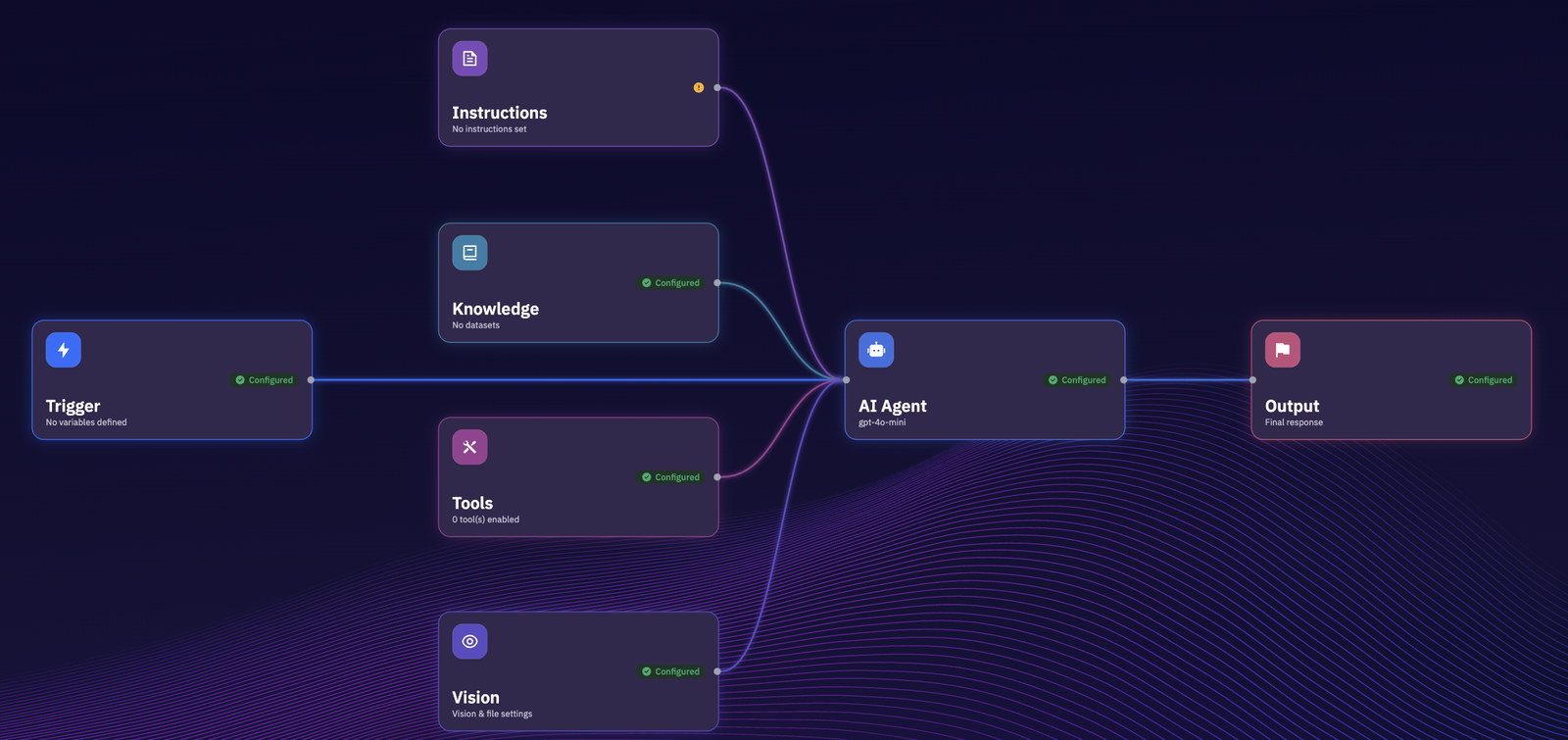
We build this, so read the rest with that in mind. Workflows run on triggers, schedules, webhooks and forms, the way they would on Make or n8n. Agents are configured rather than written, and reach customers over API, chat, WhatsApp and voice. Both are billed the same way, once per run, and every run is recorded without you instrumenting anything.
- $0 to start, with $10 of credit and no card.
- $0.001 per app execution: one execution per run, not per step inside it.
- Voice at a $0.015/min platform fee, with third-party charges passed through.
The Creator Program is covered in full further up, so briefly: you earn on accounts you refer and on templates you publish, at 40% for the life of the account rather than n8n’s 30% for twelve. Verified creators get a profile with their templates and a way to be hired. No certification, no minimum volume, no listing fee.
It is not a CRM, so it will not replace GoHighLevel for someone selling a marketing stack. Make and Zapier have far larger connector libraries, so if your client’s stack includes something obscure, check it is supported before you promise anything. We are also a smaller library than n8n’s eleven thousand templates, which cuts both ways: less to copy from, and far less to compete with. And a revenue share is not a salary. It pays what your work brings in, which may be nothing if nobody uses it.
How to choose
Five questions, in the order that eliminates the most options fastest.
- Is anyone having a conversation? If not, you need an automation tool, and Make, n8n and Xpectrum all qualify. Most “we need AI” briefs are a scheduled data move wearing a costume, so answer this before you price anything.
- How many steps per run, and how many runs? Multiply them, then check what the tool counts. Five steps on Make is five operations; the same job is one execution on n8n or Xpectrum. That multiple, not the headline price, is your monthly cost.
- Who is the account in? If you want to resell the whole stack under your own brand, GoHighLevel is built for that and nothing else here is. Otherwise put it in the client’s name and attach your referral.
- Can you answer “why did it do that?” Not in theory. Open the tool and try to find what one specific run did last Tuesday. You will be asked this in front of a client eventually.
- How long does the revenue share last? Nearly all of them pay you something, so the question is the term. Make, n8n and Botpress stop twelve months after each referral. GoHighLevel and Xpectrum do not stop.
Five ways freelancers lose money here
None of these are about picking the wrong tool. They are about how the tool gets paid, and about work you did not charge for.
- Quoting a fixed price against a usage meter. You invoice once and the meter runs every month afterwards. If the subscription is in your name, every bit of growth in your client’s traffic comes out of your margin. Put the account in their name, or rebill usage with a markup you have told them about.
- Reading the price and not the meter. $0.0009 looks cheaper than $0.001 until you notice one charges for every step and the other charges for the job. On a five-step workflow that is 4.5 times the cost, from the tool with the lower sticker price.
- Forgetting the monthly floor. Entry plans are priced for people already at volume. A client doing a thousand runs a month pays the same $9 or $29.99 as one doing ten thousand, so on small jobs you are mostly buying headroom nobody uses.
- Never attaching your referral. This is the one that costs most and takes least effort. If your client creates their own account while you watch, that subscription is attributed to nobody. Sign them up through your link and the same work pays you every month, on every platform in this comparison.
- Shipping with no run history. The first time a client disputes an answer is when you find out whether your stack can be audited. If it cannot, you are rebuilding the problem from scratch while they wait, unpaid.
Frequently asked questions
- Which AI platform pays freelancers the most?
- On published rates, GoHighLevel and Xpectrum are level and ahead of the rest: both 40%, both for the life of the account rather than a fixed term, and both with a second tier of 5% on builders you bring in. Xpectrum adds a third tier at 2.5%. Make pays 35% for twelve months, n8n 30% for twelve months on Cloud accounts only, and Botpress 30% for twelve months. Voiceflow and Zapier run programmes without publishing a rate. Be sceptical of any vendor claiming it is the only one that shares revenue, because nearly all of them do.
- How does the Xpectrum Creator Program work?
- You earn 40% of the recurring revenue from any account attached to you, for as long as that account runs. An account attaches in two ways. The first is a referral, exactly like any affiliate programme: your client signs up through your link. The second is a template: you publish an agent or workflow you already built for a client, with the setup notes another builder would need, and you earn when a stranger adopts it. There is no certification, no minimum volume and no listing fee.
- Do I have to build something special to join the Creator Program?
- No. The agents and workflows you make for a client are the same ones that qualify, so there is nothing separate to produce. You submit it with the setup notes another builder would need, and it is reviewed for accuracy rather than polish.
- If another freelancer uses my template, who gets the 40%?
- It depends on whose account the subscription is. If a business adopts your template and runs it themselves, that is your account and you earn 40% of what they pay. If the adopter is another builder who uses it to serve their own clients, those clients are their accounts: they earn the full 40% and you move to 5%, the same as any creator you brought into the programme, because a template that recruits a builder has effectively referred them. The 40% on a template is for the account the template itself created, not for every account its adopter later wins. Any other rule would mean nobody could afford to use someone else’s template.
- If someone joins the Creator Program through me, do I earn 40% on their clients?
- No, and this is the part people get wrong. The 40% is paid to whoever the account belongs to. If another builder joins through you and then wins a client, that client is their account and they earn the 40%. You earn 5% of what that client pays, on top, and the platform pays it out of its own margin rather than out of their share. A third level pays you 2.5% on clients won by builders they brought in. Every tier is a percentage of what the client pays, never a percentage of what the builder above earned.
- If I build on n8n Cloud for a client, do I earn the 30%?
- Yes, provided the client’s account is created through your affiliate link, because attribution is what the commission follows. n8n says anyone can become an affiliate and publishes no rule against referring your own clients, though it points unusual cases at its affiliate team. Two caveats. It runs for twelve months and then stops while your client carries on paying, and it applies to n8n Cloud only, so a client you set up on self-hosted n8n earns you nothing because there is no subscription to share. The same mechanic works on Make at 35% and Botpress at 30%, both also for twelve months.
- Is GoHighLevel better than Xpectrum for an agency?
- For reselling a marketing stack, yes, and nothing on this list competes with it there. GoHighLevel is built to be rebranded and resold, and if your product is a CRM, funnels, email and SMS for local businesses it is the right tool. It is a weaker fit when the deliverable is a custom agent or workflow running against the client’s own systems. On earnings the two are close enough that the programme should not decide it: GoHighLevel also pays 40% recurring for the life of the customer plus 5% on sub-affiliates, where Xpectrum pays 40%, then 5%, then 2.5%.
- Which tool is cheapest to run?
- Xpectrum, on price per run, and the reason is the meter rather than the sticker price. Make charges about $0.0009 per operation and Xpectrum about $0.001 per run, so Make looks cheaper per unit. A five-step workflow is five operations on Make and one run on Xpectrum, which makes it roughly 4.5 times more expensive in practice. Zapier bills per action step and works out around 160 times more at entry rates. There is also no monthly minimum on Xpectrum, so a thousand runs costs about a dollar where Make charges its $9 plan fee regardless. At high volume every tool gets cheaper per unit and the gap narrows, but it does not close.
- Can Xpectrum do plain automation, or is it only agents?
- Both. Workflows run on triggers, schedules, webhooks and forms, which is the same work you would otherwise put on Make, Zapier or n8n, and agents handle the conversational side across API, chat, WhatsApp and voice. They are billed identically, once per run. The honest caveat is connector coverage: Make and Zapier have far larger libraries, so check an unusual integration is supported before you promise it to a client.
- Is n8n free?
- The Community Edition is free and self-hostable, which is genuinely free in licence terms but not in time: you run the server, the upgrades, the backups and the uptime. n8n Cloud starts around 20 euros a month. The self-hosted Business licence, where SSO and the heavier controls live, was around 667 euros a month billed annually when this was written. Note that self-hosting also removes the subscription your affiliate commission would have been paid on.
- Do I need LangSmith if I use a platform?
- Usually not. LangSmith is observability and evaluation for LLM applications, not a place to build them. It earns its keep when you have written the agent yourself in code and have no other way to see what it did. If your platform already records every run step by step, adding LangSmith means paying per trace for something you already have.
- How much should a freelancer charge for an AI agent build?
- Price the build and the running cost separately, and make the running cost the client’s rather than yours. The common mistake is quoting one fixed fee, absorbing a usage-metered subscription, and watching the margin vanish as the client’s traffic grows. Put the platform in the client’s name and attach your referral to it, so the account pays you every month instead of costing you. Then ask the separate question of whether the build is worth publishing.
- What is the difference between a task, an operation and an execution?
- They are different meters for the same work, and the difference decides your bill. Zapier counts a task per action step that runs. Make counts an operation per module that processes data, so a five-module scenario costs five. n8n and Xpectrum count one execution per run regardless of how many steps are inside it. A workflow that looks identical in three tools can cost several times more in one of them.
- What happens when my client asks why the agent gave a wrong answer?
- This is the question that should decide your tool, and most comparisons skip it. You need the run: what the agent was asked, which tools it called, what came back, and what it did with that. If your stack cannot show you that, your only options are to guess or to rebuild the problem, and you will be doing it while the client waits.
If the shape of this appeals, the cheapest way to test it is to build your next client job on Xpectrum and publish it when you deliver. Start free with $10 in credit, or read how the Creator Program works first.